Shaker Cabinets Online: Reading Door Specs
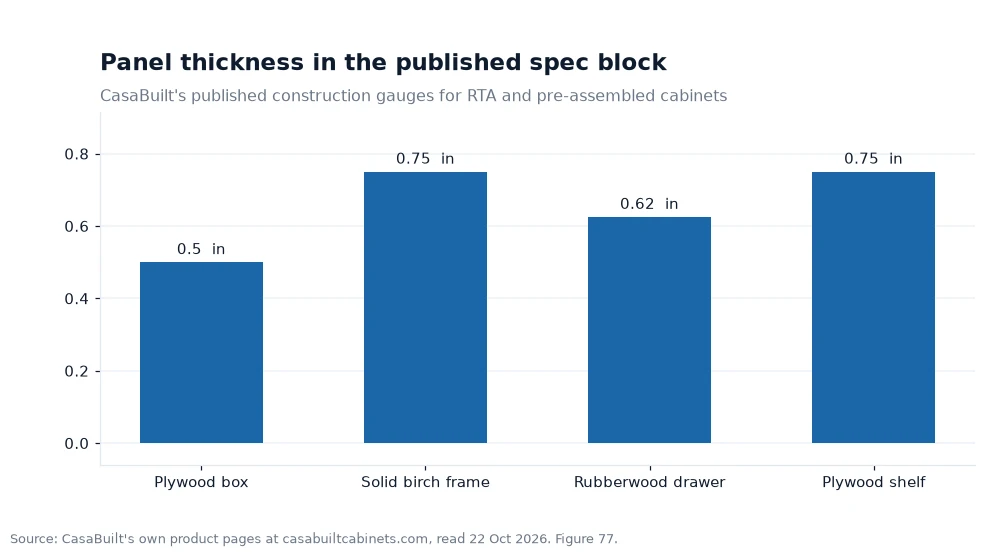
Two listings can show the same white Shaker door and describe two different cabinets, because the door is only the visible third of the product. The numbers that decide how it feels in year five are in the spec block: a 1/2-inch birch plywood box, a 3/4-inch solid birch face frame, a 5/8-inch rubberwood drawer side and a 3/4-inch plywood shelf. A buyer who can read those four lines can tell a serious cabinet from a photograph of one.

Key takeaways
- Panel thickness is a design decision, not a rounding error: 1/2 inch, 5/8 inch and 3/4 inch all appear in one cabinet.
- The face frame is 3/4 inch by 1-1/2 inch solid birch, which is the part that holds a run straight.
- Soft-close is a hardware spec, and the hinge is listed as six-way adjustable.
- The finish is seven layers of paint with a UV protective topcoat, and the warranty runs one year against manufacturing defects.
A listing is a short document with long consequences
Online cabinet shopping compresses a purchase that used to involve opening a drawer in a showroom. What survives the compression is text, and text is where a buyer either gains an advantage or loses one. The useful habit is to read the listing in a fixed order: door, box, hardware, finish, then price. Price last, because price is only meaningful once the first four are known.
Most listings lead with the door, which is reasonable. The door is what the buyer sees and what the kitchen is judged by. The problem is that a door can be well made on a cabinet that is not, and the reverse is also true: a plain door on a solid box is a better purchase than a beautiful door on a box that flexes when it is carried.
So the door gets two questions and the box gets four. What is the frame made of, and what is the center panel? Then: how thick is the box, what is the interior, is there a face frame, and how thick is the shelf?
Read the box before the door
The box is a five-sided plywood structure with a back panel, and its job is to stay square while carrying the weight of everything inside it. CasaBuilt publishes 1/2-inch birch plywood for the box, a natural birch interior and color-matched exterior sides. The face frame is a separate piece of solid birch, 3/4 inch thick and 1-1/2 inches wide, applied to the front edge.
Why does that combination matter? A 1/2-inch plywood panel is light enough to hang a wall cabinet on a pair of studs without a fight, and a 3/4-inch solid frame gives the front edge something rigid to hold screws, hinges and the door's weight. The frame is the reason the cabinet does not bow between the mounting points.
The drawer box is where cheap cabinets hide. The published spec is a 5/8-inch rubberwood side with dovetail joinery, which means the corners are interlocking cuts rather than staples or dowels. Dovetail corners do not pull apart when a loaded drawer is yanked, and the 5/8-inch side resists the bow that turns a drawer into a wedge.
The spec block, line by line
The advantage of a published spec block is that it can be compared with another one line by line. CasaBuilt's runs to nine entries, and six of them are things a buyer can inspect on a delivered cabinet with a tape and a flashlight.
| Spec | Published detail | What to check on delivery |
|---|---|---|
| Box | 1/2 in birch plywood, natural birch interior | Panel edges are ply layers, not a uniform chipboard core |
| Face frame | 3/4 in by 1-1/2 in solid birch | Frame flush along its length, no filler at the joints |
| Door | Rubberwood frame with MDF panel, full overlay | Even rail width on all four sides of the door |
| Hinges | Soft-close, concealed, six-way adjustable | Door closes without a bounce, gaps even top and bottom |
| Drawer glides | Soft-close undermount, full extension | Drawer opens past the counter edge and returns on its own |
| Drawers | 5/8 in rubberwood, dovetail joints | Interlocking corner cuts, no staples |
| Shelves | 3/4 in plywood, adjustable | Shelf pins seated, no sag with weight in the middle |
| Finish | Seven layers of paint with UV protective finish | No thin or dry patches along the door edges |
Two entries in that table are unusual to see published at all: the hinge adjustment count and the number of finish coats. Both are easy to state and hard to fake, which makes them useful. A hinge that is described as six-way adjustable can be tested with a screwdriver in ten seconds. Seven coats cannot be counted, but a finish that has them looks level at a raking angle.
Finish and warranty deserve the same scrutiny
Paint is a material, not a color. Seven layers with a UV topcoat is a schedule built for a kitchen, where steam and sunlight both attack a painted surface. The UV layer matters most on white and pale doors, because those are the finishes that show a shift first. A buyer comparing a seven-coat door with a two-coat door is comparing two different maintenance loads, even when the color chips match.
The warranty is documented at one year against manufacturing defects in materials and workmanship under normal residential use, with support providing a replacement part or another appropriate solution. That is a defect warranty, not a wear warranty, and it does not cover damage from installation or transit. Read it before the order, not after.
Specifications are also easier to compare when the pages are complete, which is the practical argument for a catalog that publishes the same block across a range. The set of shaker cabinets online repeats the construction detail on each style page, so a buyer can hold the door finish constant and compare only the box. The RTA kitchen cabinet collection adds the assembly and shipping notes that the door pages leave out.
Worked example: the four gauges in one cabinet
The chart lists the four published thicknesses: plywood box 0.5 inch, solid birch frame 0.75 inch, rubberwood drawer 0.625 inch and plywood shelf 0.75 inch. In eighths those are 4/8, 6/8, 5/8 and 6/8, and the sum is 0.5 + 0.75 + 0.625 + 0.75 = 2.625 inches, or 21/8. Divided by four, the average gauge is 0.65625 inch.
Compare the panels by area instead of by a single dimension, because that is what a buyer actually pays for. A base cabinet side panel is 24 inches deep by 34-1/2 inches high, so its face is 24 x 34.5 = 828 square inches. At 0.5 inch thick the panel contains 828 x 0.5 = 414 cubic inches of plywood. At 0.75 inch it would contain 828 x 0.75 = 621 cubic inches, which is 621 - 414 = 207 cubic inches more, or exactly 50 percent more material.
That is the arithmetic behind the phrase heavy-duty box. A 3/4-inch panel carries half again as much material as a 1/2-inch panel of the same area, so it resists flex in proportion. The published cabinet puts the thin gauge where weight is low and the two 3/4-inch gauges where the load is: the front frame and the shelf. The 5/8-inch drawer side sits between them, at 0.625 - 0.5 = 0.125 inch thicker than the box and 0.75 - 0.625 = 0.125 inch thinner than the shelf.
Frequently asked questions
Is a 1/2-inch plywood box too thin for a kitchen?
It is the published gauge for this cabinet, and it is paired with a 3/4-inch solid birch face frame that carries the front edge. The combination is what matters: a thin box with a rigid frame behaves differently from a thin box on its own. Wall cabinet depth is 12 inches, where the span is short and the load is mostly shelf weight.
Is an MDF door panel a downgrade from solid wood?
Not for a painted Shaker door. MDF is dimensionally stable and takes paint to a smooth face, which is why it is used behind a rubberwood frame in this spec. Solid wood panels move with humidity, and on a painted door that movement shows up as a visible seam line over time.
What should I ask before ordering a Shaker door online?
Ask for the box material, the face frame dimensions, the drawer side thickness and the joinery type, the number of finish coats, and the warranty terms in writing. If a listing will not state the box material, treat the price as incomplete rather than low.
Compare three lines before you compare three prices
Pull the spec block from two or three listings and put them side by side. The one with the shortest block is usually the one with the most to hide, and the one with the longest is not automatically better, only more checkable. Then order a sample door and look at its edge, because the frame material is visible there.
A cabinet is a box with a door on it. Buyers who read the box first tend to keep the kitchen longer.
Figures quoted here come from the manufacturer's own website, read 22 Oct 2026[1].